
Small room acoustic teaching
Upper frequency
Comb filtering
Small rooms are acoustically radical different from large concert halls. In a concert hall one avoids to a large degree early arriving specular reflections. In a small room however, reflections are a great challenge due to the closeness of surfaces. Late arriving specular reflections can also be detrimental.
The result of these reflections that arrive from the floor, ceiling and walls is comb filtering. The reason it’s called comb filter is because they look like a comb when measured and seen in a graph.
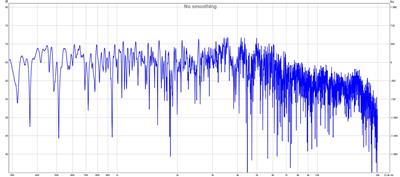
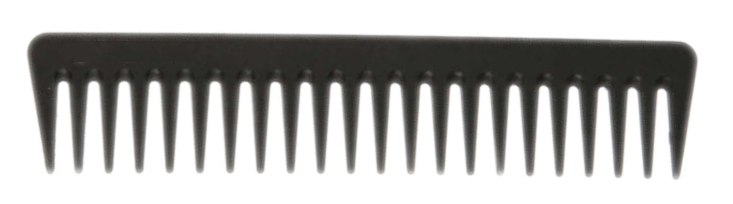
There are peaks and cancellations at different frequencies due to a delayed sound introducing a phase shift. This gives an uneven frequency response and has negative effect on areas like tonality, clarity, intelligibility, precision and localization. The sound can be perceived as messy, often causing fatigue for prolonged listening periods.
In relation to mixing and mastering, high amounts of specular reflections makes it significantly more difficult to hear the recorded signal with clarity and accuracy. The negative contribution from the control room will dominate. This can easily lead to over-compensating when mixing and mastering, often by applying EQ and reverb based on faulty assumptions. The end result is often degraded and there’s a lack of predictability of the end result and loss in how well a mix will translate to different listening environments.
The graph below shows a measurement of a speaker outdoor (black) and indoor (blue). Here we can clearly see how much the room changes the frequency response and sound when a room isn’t acoustically treated. A common misunderstanding is believing that EQ/room correction alone can solve the room issues. However, for a good result physical treatments is needed and EQ may be applied with care at the end.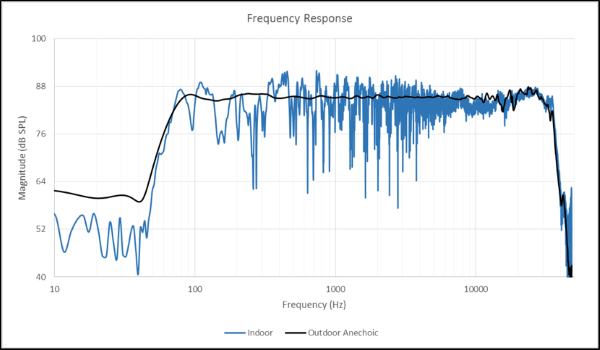
Flutter-echo
Smaller rooms also struggle with flutter echo. This can often be described as too much «reverb” in a room. Flutter echo is caused by the sound energy going back and forth between two untreated parallel surfaces. This can be either between two walls or between floor and ceiling. When the time period is short, it will degrade clarity, precision and the timbre of the music. Flutter echo sounds like this:
Treatment
There are three ways to treat comb filtering and flutter echo: Absorption, diffusion and redirecting the sound energy. The better choice depends on the size of the room, what’s practical and type acoustic principle one wants to follow. By using splayed walls and ceiling, one can redirect the sound. This is primarily done in studios that are built from the ground up.
Absorption and diffusion is more typical treatments in rooms that are not being designed from the ground up. Whereas absorption panels absorbs the sound, diffusers spread the sound out in time and space.
Room modes
Room modes, also called standing waves or eigenmodes, are variable sound pressure at different places in the room for low frequencies. They arise because of the reflections between surfaces and can be a significant challenge in small rooms. The size of the wavelength for low frequencies are big and one can picture them acting as waves in a bathtub. Some places they arise like peaks (nodes) and other places they are low with cancellations (antinodes). There are different kinds of room modes depending on which surfaces are involved. Peaks leads to a resonant and boomy bass with poor bass definition. With cancellations there’s a lack of bass and foundation to the music. And when the bass has a long decay, it becomes monotonous, muddy, slow and without feeling of slam, suddenness and kick.
Optimal placement for both the speakers and the listening position is vital for the most even low frequency response and this is where one should always start. Bass trapping is still essential in all small rooms for tight and great bass. The word bass trap may cause misunderstandings and give the idea it merely removes bass. However, what bass traps do is to both lower peaks and raise cancellations as well shorten the decay. The bass response becomes flatter with less resonances due to a minimization of reflected energy. The result is a much better and prominent bass.
A waterfall graph shows us how the low frequency energy in both frequency (amplitude) and in time. The time domain is often overlooked but is also essential for a quality bass. The time in the waterfall shows how long the bass resonances remain or decay in the room. This is something no EQ can’t fix. EQ only works when the response is so called minimum phase, which it normally only to a certain degree at the very lowest frequencies. But even then, using EQ is compromise because one looses headroom and thus potentially dynamics, and the EQ only applies to a smaller area in the room. With proper bass treatment, the headroom and dynamics are preserved and works in the whole room. Physical treatment is always better than using an EQ. EQ should only be applied at the very end when absolutely necessary
Different kinds of bass traps
There are different types of bass traps. Normally one distinguishes between porous based traps that work based on the velocity of the sound wave, and pressure based traps which work where the pressure of the room modes is high. Porous based traps are broadband and operate in a wide frequency area. Because they work where the velocity of the sound waves is high, they need to build out considerably from the surface in order to be effective. At surfaces the velocity is practical zero. This means, unless they are extremely big (perhaps 1 m or more in depth), they are not effective at low frequencies. Thus they can become unpractical in most rooms.
Pressure based traps are on the other hand very effective close to the surfaces and don’t need to build out much. Many pressure based traps are narrow banded, meaning they work in a very limited frequency area. An example of this is the typical Helmholtz resonator box. Despite being effective at the frequencies they are tuned to, they are not optimal to use on their own as most of the other low frequencies are unaffected.
We sell different types of bass traps and some that are unique in the way that they both have high effect for very low frequencies while also operating over a wide frequency range. The use of these result in an improved and tightening of all the lower frequencies. Read more about our bass traps here.